
Some 600 young Australians served with the British Army’s Royal Flying Corps (RFC) during the Great War, many losing their lives. One young fighter-pilot from Melbourne who gave his life was 2nd Lt Lyle Buntine MC, the son of the Principal of Caulfield Grammar School. Lyle’s tragic accidental death, following gallant service as a fighter pilot during the Battle of the Somme, was notable in that his family preserved every letter, newspaper article, photograph and artefact associated with his life and active service. His extensive correspondence, which has never before been published, provides the basis for this book, which follows his life from his school days to active service in the fledgling RFC and to his untimely death. Lyle’s letters trace his voyage to and travels around England, his life as an officer in the British Army, his training adventures on primitive RFC aircraft and his combat experiences on the Western Front, including surviving being shot down six times! These letters bring to us a forgotten voice from the past resounding with humility and humour, coupled with absolute fear. Also explored in this book is the manner in which his family and school mourned his death and marked his memory. His family’s struggle to come to terms with the loss in war of their ‘Empire’s Noble Son,’ was an echo of the deep grief manifest in the wider Australian society at the end of the Great War.
These letters bring to us a forgotten voice from the past resounding with humility and humour, coupled with absolute fear.
‘The importance of this publication is that it brings to life the thoughts and ideals of young Melbourne man ‘Lyle’ Buntine who emerged from a school very much modeled on the British schools of the time. He lived in an Australian society in the early 20th century still dominated by links to Britain and along with many others, saw it his duty to serve the Mother Country in a time of war. He truly was ‘Empire’s Noble Son.’ Dr Jeanne Shaw. Author and former VCE English examiner.

If you didn’t know that Australians were involved in the longest campaign of WWII, in Burma, in what was called ‘a forgotten war’, this book illuminates the lost stories of their service. ‘In the Fight‘ tells the compelling stories behind the involvement of Australians in what became one of the great sagas of the war against the Japanese in South East Asia, encompassing India, Ceylon, Burma, China, Thailand and Vietnam. While Australian airmen attached to the Royal Air Force were heavily engaged, many Australians both uniformed and civilian were part of the monumental struggle to turn ‘defeat into victory’ in Burma. Australian war correspondents, Red Cross nurses, Royal Australian Navy sailors, war artists, commandos and saboteurs, soldiers serving with the Indian and British Army, sportsmen, the Women’s Auxiliary Service (Burma), well known sportsmen, government officials dealing with the terrible Bengal famine, Qantas crews and Australian POWs in the Rangoon Jail are all covered in these detailed accounts. Written by leading authorities and expertly edited by Dr Andrew Kilsby and Dr Daryl Moran, ‘In the Fight‘ reveals the long-hidden stories of the Australians and the war in Burma.
‘In the Fight‘ tells the compelling stories behind the involvement of Australians in what became one of the great sagas of the war against the Japanese in South East Asia.’
‘… several thousand individual men and women represented Australia in the fight against the Japanese in the Burma theatre of war. This volume demonstrates that war is not always about the big battalions, but is the story of individual men and women and their personal contribution to victory.’ Dr Robert Lyman. MBE FRHistS
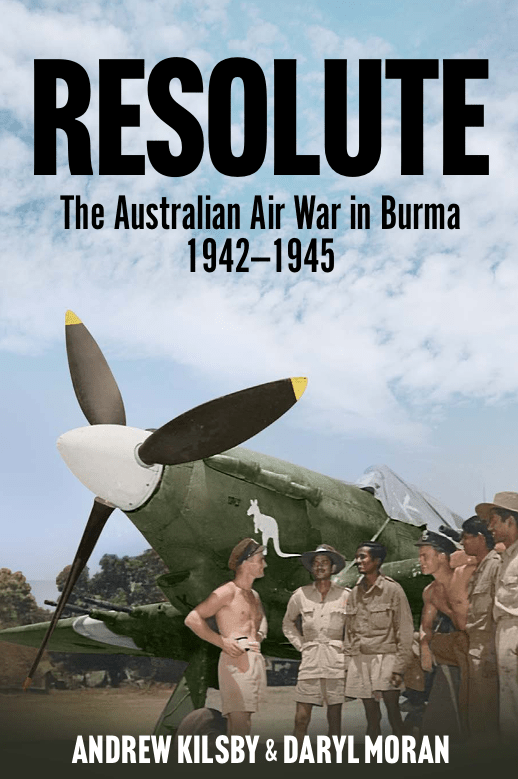
In this compelling account of a forgotten war, the vital yet largely overlooked contribution of Royal Australian Air Force aircrew during the Burma campaign of 1942 – 1945 is brought to life in the first detailed history of their service and sacrifice. More than 1,700 Australian airmen were engaged in the air war across the South East Asian theatre. Integrated into the Royal Air Force (RAF) squadrons centred on the Burma campaign, they were joined by other Australians serving directly within the RAF. Operating in extreme conditions – across rugged terrain, through monsoonal weather and in a relentless tropical climate – these Australians faced a determined Japanese enemy. The courage and endurance of these young Australians and their purposeful, determined and unwavering service and sacrifice, proved significant in the monumental struggle to turn defeat into victory in Burma. ‘Resolute’ reveals for the first time in expertly researched detail, the triumphs and tragedies of Australia’s forgotten air war in the Burma theatre.
… their purposeful, determined and unwavering service and sacrifice, proved significant in the monumental struggle…
‘This work, ‘RESOLUTE’ provides long-overdue recognition of the courage, bravery, endurance and sacrifice of the Australian aircrew who served in South East Asia Command during the Second World War. The authors have ensured that the contribution of the Australian airmen in this theatre is not forgotten. ‘ Dr Karl James. Head, Military History, Australian War Memorial

‘Suddenly, the Boers opened fire on us from two hills on the left of the road, and we knew we had ridden into a trap. We quickly dismounted but were lying out in the open. I was on my back when a bullet hit the ground at the back of my head and threw dirt over my face. That was the closest shave I had.’ The wily Boers were ‘crack shots’, and being attacked by accurate enemy rifle fire was a common experience for young men who served the Empire during the Anglo–Boer War of 1899–1902. Fighting as mounted infantry, they often patrolled on horseback for weeks at a time in hot, dry conditions. Long days of boredom and daily routine would be punctuated by unexpected and terrifying encounters with the elusive Boer irregular soldiers. How was it that Australians were involved in this war on the other side of the world? What motivated these young men to sail over oceans and choose to fight an enemy of which they knew little? How did their communities recognise their service and sacrifice? ‘First to Serve and Sacrifice’ tells the story of why young Australians were willing to go to war for ‘God, Queen, and Country’. It shares the stories of twenty-eight young men, told in their own words. As graduates from Caulfield and Malvern Grammar Schools, their stories also provide an insight into the culture of Australian society at that time. Seven of these young men died in the war, and several others received serious, life-changing wounds. Their story deserves to be read by a contemporary audience.
‘First to Serve and Sacrifice’ tells the story of why young Australians were willing to go to war for ‘God, Queen, and Country’.
Buy this book at Echo Books at https://www.echobooks.com.au/books/first-to-serve-and-sacrifice
 darylmoran.com