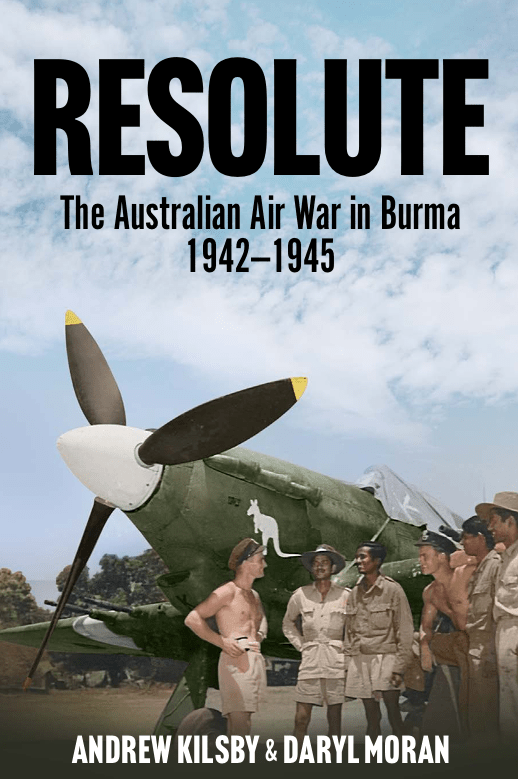
Launched at Melbourne’s Shrine of Remembrance in October 2025, by May 2026 the book has already sold over 500 copies across Australia.
Resolute‘ is a thoroughly good read, packed with information that’s presented in an easily digestible way, and for me it’s proving a real eye-opener into aspects of WWII about which I have to admit I was lamentably unaware.
Dr Andrew Kilsby and Dr Daryl Moran have provided a comprehensive account of the role of the RAAF in the Burma Campaign, and that does a fine job providing the recognition that the Australian personnel deserve. Highly recommended to anyone with an interest in WWII aviation and the RAAF in particular.’
The link to the latest RESOLUTE book review is below.
https://aeroscale.net/news/resolute—the-australian-air-war-in-burma-1942-19451
Sabretache vol. LXVII, no. 2 – JUNE 2026. pp41- 42 (Military History Society of Australia)
REVIEWS
Resolute: The Australian Air War in Burma 1942-1945
Dr Andrew Kilsby & Dr Daryl Moran
Big Sky Publishing, Newport 2025 Paperback, $36.99
Despite Winston Churchill’s wish that the Australian divisions returning from the Middle East be diverted to take part in the Burma campaign, the 2nd AIF did not become involved in that theatre of the Second World War. A substantial number of Australian service personnel did qualify for the Burma Star medal, however. Chiefly, they consisted of individual members of the Royal Australian Air Force assigned to Royal Air Force units serving in Burma but also included Australians who had enlisted directly into the RAF and found themselves posted there. Resolute: The Australian Air War in Burma 1942-1945 documents the experiences of both groups and does so thoroughly and very effectively. From the outset, Australian airmen made up a sizable proportion of the RAF squadrons operating in Burma and continued to do so until final victory in 1945. They served in a multiplicity of roles: in fighters, tactical and strategic bombers, reconnaissance and transport aircraft, on coastal and air-sea rescue duties, and in a variety of administrative and support tasks as well. And unfortunately, many downed aircrews found themselves prisoners of the Japanese, forced to endure the horrors of prison camp life until death or the war’s end freed them at last. Ultimately, over 1700 RAAF airmen were involved in the campaign, but as authors Kilsby and Moran assert, their story, along with that of the Australians in the RAF itself, ‘has been largely overlooked, or rather, subsumed within the RAF narrative’ (p.4). Partly this is because there were no discrete RAAF units operating in the region – not even any of the so-called Article XV squadrons with 400 numbers which, regardless of their recognisably Dominion identities, were under RAF control. All the squadrons were from the RAF establishment, with Indian Air Force units – which also contained some Australian aircrew and staff – eventually joining in. Another reason for the relative obscurity of the Australian story is that within the broader context of the Second World War, Burma has often been referred to – with some justification – as the forgotten campaign, especially in comparison to the literature that has emerged from the other theatres of war. Resolute endeavours to throw light on and acknowledge the contribution of Australian airmen to victory in Burma, especially to the many who lost their lives in that effort. Using a wide range of archives, official histories and secondary sources, the authors have created a multi-faceted narrative which is both chronological and thematic in approach. Thus the account of the Australians’ involvement in Burma from beginning to end is interspersed with chapters dealing with various aspects such as the measures taken in air defence against enemy incursions over India and Ceylon; the significance of air transport towards winning the war on the ground; the development of a strategic bombing campaign beyond the Burmese front; and the vast distances involved in carrying out reconnaissance flights over the Indian Ocean. Of particular interest are chapters dealing with prisoners of war, including the remarkable story of Wing Cdr Hudson and the inmates of the Rangoon Jail; and of the work of the RAAF Liaison Office in trying to meet the many needs – administrative, material and psychological – of such a widely dispersed group as the Australian airmen in Burma and India. Two other aspects are worthy of note in value adding to Resolute as a resource for researchers, medal collectors and the like. The first is the decision to name only Australian personnel in the narrative; if a name appears, it is an Australian. The second is the splendid Nominal Roll, giving name, service number and any awards, of the 1700 or so airmen in the campaign. This alone would have taken a great deal of time and effort to compile and is more than enough reason for anyone with a connection to or interest in the Burma campaign to obtain a copy of the book.
‘Resolute is an excellent example of the continuing efforts of historians to discover and describe the achievements of Australia’s service personnel at war.’
Reviewer: Dr Paul Skrebel. FMHSA

